Scrum events
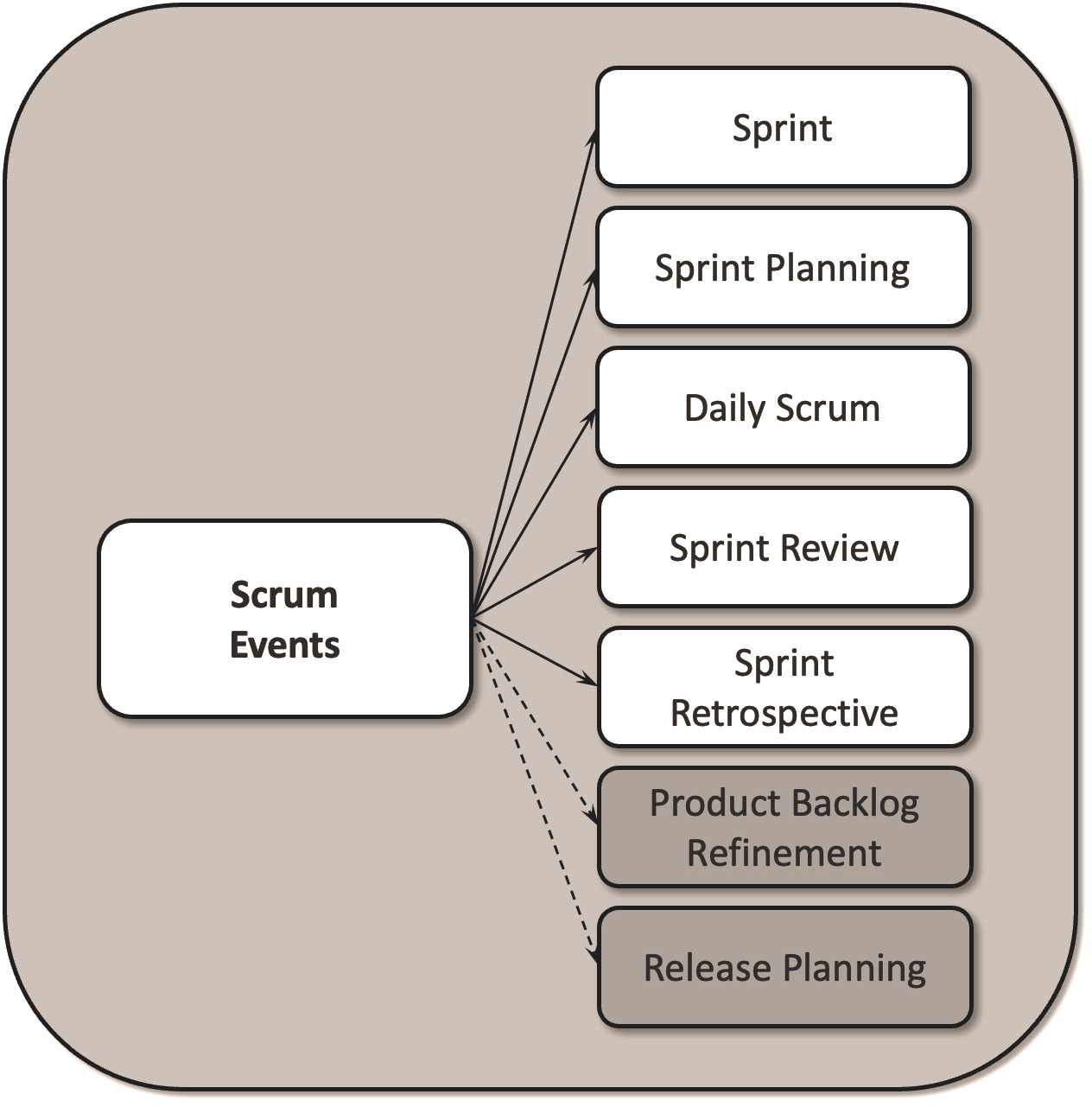
Scrum events are meetings held by members of the Scrum Team in addition to the development cycle itself – the Sprint – which contains all the other events.
The Scrum events create a routine for Scrum Team members. Based on the regularity for their realization imposed by the framework, the events generate a cadence that the Scrum Team members get used to. To reinforce this consistency and reduce complexity, the Scrum Guide recommends that the events are always held at the same time and in the same location (SCHWABER; SUTHERLAND, 2020).
Since they are mandatory and cover crucial issues related to planning, executing and verifying the development work for the product, Scrum events also aim to minimize the need for other meetings not defined by the framework.
By bringing clear objectives and the necessary transparency, each event provides a formal opportunity for the Scrum Team to inspect and adapt different Scrum artifacts, thereby promoting empiricism. Remember that the three pillars of Scrum are transparency, inspection and adaptation (see more about empiricism and the three pillars in the section Scrum is based on empiricism in the chapter What is Scrum?).
Also called ceremonies by many, the meetings are the Sprint Planning, the Daily Scrum, the Sprint Review and the Sprint Retrospective.
To the Scrum events I add a short work initialization phase, the Product Backlog Refinement sessions and the Release Planning meeting, all of which are additional to what the framework prescribes and not mandatory.
Definition: Scrum timeboxes
With the exception of Sprints, which have a fixed duration, each Scrum event has a defined maximum duration, called a timebox.
The main objective of timeboxes is to limit the period in which a purpose should be achieved, so that waste is not generated with endless work. Timeboxes help create a rhythm or regularity to the Scrum Team’s work.
Using as a reference the fixed duration of a Sprint of up to one month, the official Scrum guide defines the Sprint Planning meeting as a timebox of up to eight hours, the Daily Scrum of up to 15 minutes, the Sprint Review of up to four hours and the Sprint Retrospective as a timebox of up to three hours (SCHWABER; SUTHERLAND, 2020). The guide suggests that if the Sprints are shorter, the meetings should be generally shorter as well.
Until the 2011 Scrum guide, the official recommendation was that the maximum duration of the meetings be proportional to the duration of Sprints, except for the Daily Scrum meeting. Thus, for two-week Sprints, the Sprint Planning would last a maximum of four hours, the Sprint Review, two hours, the Sprint Retrospective, an hour and a half and the Daily Scrum meeting would last a maximum of 15 minutes (SCHWABER; SUTHERLAND, 2011). I still consider this a good recommendation.