Agile
Merriam-Webster defines “agile” as: able to move quickly and easily (AGILE, 2020).
But our use of “agile” doesn’t mean “do it quickly” or “deliver quickly” – it has much more to do with having and exercising the ability to adapt. The name “Agile” was chosen to represent a movement that emerged in the mid-1990s in response to the burdensome management methods for software development that prevailed at the time, which for simplicity I will call “traditional methods.”
The best-known representative of traditional methods for software development is the so-called waterfall model. It was initially described by Winston W. Royce in his 1970 article. The waterfall model is characterized by a sequence of work phases in which each phase only starts when the previous one ends and the output of one phase is the input of the next phase, as shown in the following figure. Royce, however, criticized the model, stating that its use for software development was risky (ROYCE, 1970).
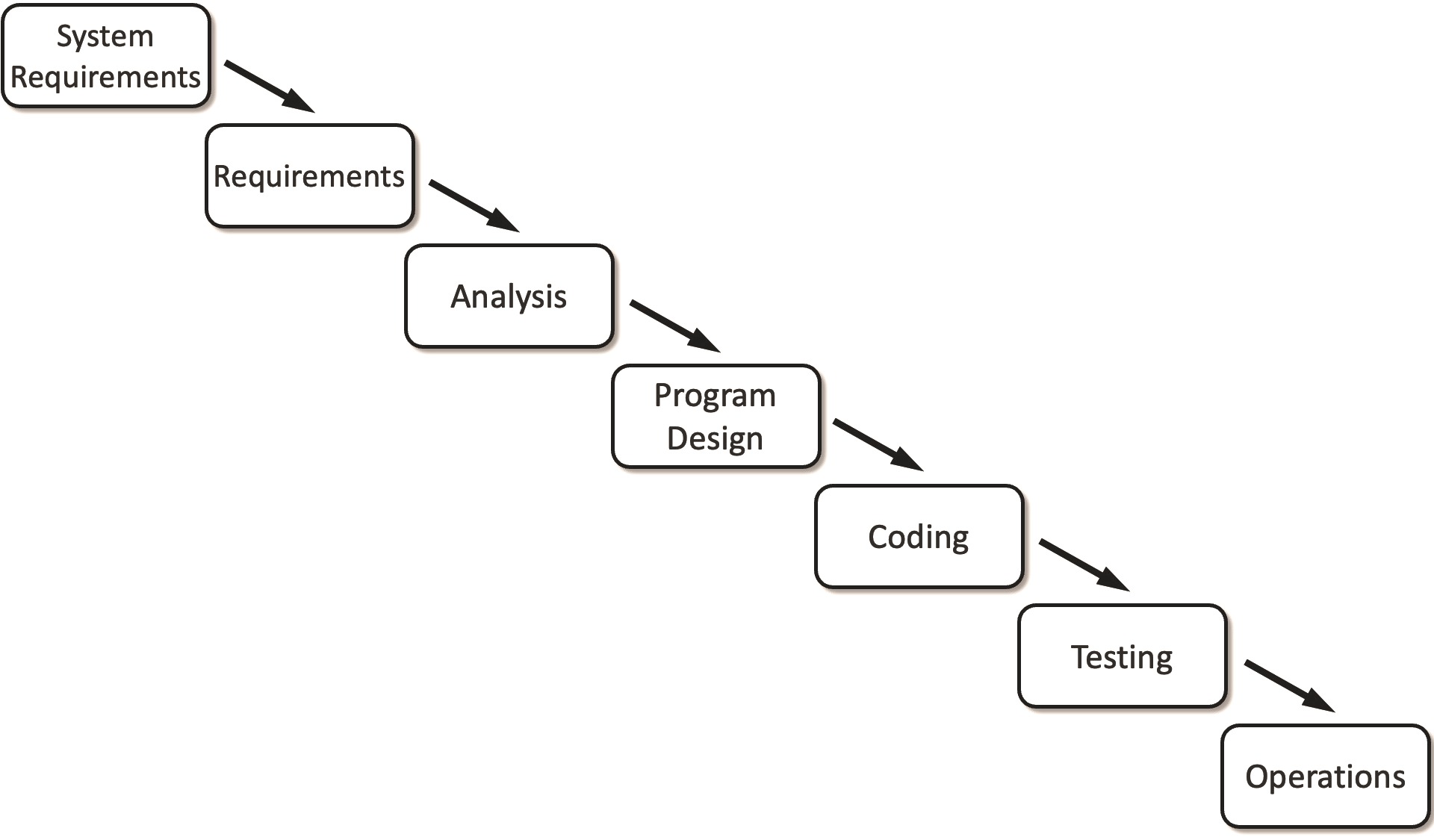
Traditional methods are strongly prescriptive and, in general, are characterized by BDUF – that is, focused on detailed and defined plans at the beginning of the project (with cost, scope and schedule) and micromanagement of the work with centralized power, not to mention complicated processes and extensive documentation. Changes are strongly discouraged, and success lies in being able to adhere to the plan as faithfully as possible.
It was believed that by using these methods it would be possible to treat software development as a predictable process. But in reality, the more they failed, the more cumbersome and complex these methods became.
Definition: BDUF, the great enemy
Big Design Up Front, or BDUF, is a term used to describe the practice of specifying in detail the work to be performed (originally, software development) before starting that work (BIG DESIGN UP FRONT, 2013). Associated with this practice is the strong belief, mistaken in my opinion, that BDUF is the most correct and safe way to develop a product.
I consider BDUF to be the most harmful practice of the waterfall model when the work is not predictable, as in software development. Scrum was created precisely to combat BDUF. In Scrum, there is no room for “BDUFing,” or “BDUFers.”
While the BDUF paradigm is to plan ahead as much as possible, the Scrum paradigm is to develop a highly adaptable product, that is, capable of responding to changes and to the emerging understanding of what must be built.
The use of agile methods, methodologies and frameworks must follow the principles and values of the Manifesto for Agile Software Development (BECK et al., 2001). This manifesto was created in February 2001 during a meeting that took place at the Snowbird ski resort in the state of Utah, United States. The Agile Manifesto, as it became known, was signed by seventeen leaders representing ideas, methodologies and processes that, in contrast to the prevailing practices at the time, brought value to their customers and users through lightweight, empirical approaches to software development.
At this historic meeting, there was no initial intention among the participants to unify their ways of working. Their expectation of reaching any kind of consensus was limited and varied. Nevertheless, despite the different practices advocated, the participants found a set of values in common. At the end of three days, they established the term “Agile” to represent this new movement. In this book, “Agile” is used as a noun, and “agile” as an adjective, both however referring to this movement.
The Agile Manifesto can be found at https://agilemanifesto.org in several languages (I myself participated in the translation effort to Brazilian Portuguese). By searching the internet for the names of the Manifesto’s original signatories and their ideas, we can see how representative most of them still are.
For didactic purposes, I created an unofficial definition for “Agile” that I use in my classes:
Agile Being agile means constantly adapting, with the goal of delivering the greatest possible value to your customers at every moment, based on the work of individuals and their interactions - my definition.
Fun fact: Mike Beedle
I had the pleasure of talking to and interacting with one of the signatories of the Manifesto, the late Mike Beedle, during the 2014 Scrum Gathering in Rio de Janeiro (http://scrumrio.com). He, my business partners and had a few beers when Mike showed us on his cellphone a list of the names that were considered for the movement at that meeting in 2001. He was the one who suggested the term “Agile.” Among other words on that list, I saw: “adaptive.”
Mike Beedle co-authored the first Scrum book, published in 2002 (SCHWABER; BEEDLE, 2002) and was a Scrum Alliance Certified Scrum Trainer (http://scrumalliance.org), just like I am.
Sadly, Mike Beedle passed away on March 23, 2018, in Chicago, following an apparent robbery. He left six children.